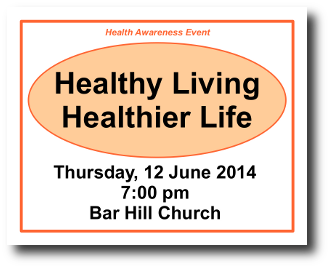
 health awareness event - healthy living, healthier life
| home | meetings | events | miscellanea | contacts |
| hae |
health awareness event - healthy living, healthier lifeDespite competition from fine summer weather and the opening ceremony of the 2014 FIFA World Cup, there was an excellent turnout of 80 people or more. John Doland, chairman of the Maple Surgery Patient Participation Group, opened the evening with a general welcome.
Dr Shapiro spoke on the topic of What Makes Your Heart Healthy? Deaths from heart-related disease peaked in the late 1960s and early 1970s, but current death rates from cardiovascular causes are 50% of what they were at that time. Heart disease follows a natural progression with the sides of the arteries gradually furring up with fat as a person ages. This process starts early and continues throughout one's life. What can be done to prevent and slow down this progression?
There are a number of lifestyle choices that negatively impact heart health. These include
Cholesterol levels can be controlled by medications called statins. These are well-researched, well-understood, reliable drugs which can reduce the risk of heart disease by a third by reducing the amount of cholesterol in the blood. Dr Shapiro emphasised that although there were side effects like muscle pain, statins were safe and well-tolerated by most patients.
The number of men smoking has been declining for years but the number of women taking up the habit has been increasing until just recently, possibly as a strategy to lose weight. A smoker is 2.5 times more likely to die from heart disease than a non-smoker.
Dr Shapiro showed an interesting diagram showing where excess fat goes in the body. It does not lie just under the skin but is packed around the internal organs where it affects the function of those organs. Unfortunately, humans have evolved to gain weight in order to ensure survival through periods of poor food supply (such as the winter). Fat parents tend to have fat children who develop early health complications as a result. The current generation of children, a third of whom are overweight, may turn out to be less healthy than their parents and have shorter lifespan.
Who gets heart disease?
The risk of heart disease doubles for those with diabetes.
Dr Shapiro concluded his talk by taking questions from the audience:
Q: At what age should you stop taking vigorous exercise?
A: There is no limit for those who are already active. Sudden death in athletes, regardless of age, is rare but gets a lot of press attention.
Q: Is there a natural alternative to statins?
A: Dr Shapiro wasn't aware of any alternative remedies. Pharmacologically there is nothing close. Also, natural remedies are unregulated whereas drugs are closely tested and monitored.
Q: What about plant sterols?
A: The evidence available has been provided by the various manufacturers. They haven't been tested independently.
Q: Does the heart revascularise after a heart attack?
A: Nature hates a blockage so it tries to replace any blockage with a network of fine blood vessels. If this happens slowly over a period of time, the person may not even be aware of it happening. However, a heart attack is a sudden affair and the body doesn't have time to put new blood vessels in place.
Q: What is the connection between thyroid function and cholesterol levels?
A: So-called 'bad' cholesterol or LDL rises when a person is hypothyroid (has an underactive thyroid) and falls when a person is hyperthyroid (has an overactive thyroid).
Her talk was entitled Eating Well, Living Well. She began with a slide showing the effect of diet on health. Diet directly impacts health along the nutrient pathway and indirectly (via body weight) along the energy pathway. Overeating by as little as 100 calories a day can lead to an increase in weight of half a stone over a year. To put this in perspective, a single shortbread biscuit can contain 100 calories! So it is very easy to gain weight but far more difficult to lose it.
We tend to gain weight as we age. Weight peaks between 30 and 60 years of age and tends to decline after the age of 70. This is due to a number of causes, including loss of appetite and intestinal malabsorption. BMI stands for Body Mass Index and is a crude measure of obesity. It varies with ethnicity, age, gender, etc. Excess weight carried around the waist is the most dangerous and leads to a higher risk of health problems. In fact, waist measurement, in conjunction with BMI, is a good indicator of health risks. Higher risks occur for men with a waist measurement in excess of 40 cm and for women with a waist measurement above 34.5 cm.
Obesity raises the risk of many chronic diseases, including cancer, diabetes, hypertension and sleep apnoea (interrupted breathing whilst sleeping). However, even moderate weight loss can prevent or delay the onset of serious illness. Benefits begin with a weight loss of just 10% of total weight.
Diets don't work! The more you diet, the worse the eventual outcome. What happens when you reach you weight goal? Most people abandon the diet and their weight creeps up again, leading to a fresh round of dieting. Instead, you should make small lifestyle changes and be realistic. The biggest effect will be in what you eat. Quality of food is important and fruit and vegetables are the most important component. You must look beyond grams, calories, 'good' food and 'bad' foods. Incorporate
into your diet. Don't add salt and don't add sugar.
The Mediterranean Diet is considered the best overall diet. However, go easy on the red wine! Don't fall for the latest newspaper or magazine hype on diets. For more information, check out the NHS Choices web site and look for 'Behind the Headlines'.
The talk ended with an interesting quiz on food and diet, including an eye-opening demonstration on what two kilograms of fat looks like. It's more than you think!
Local fitness trainer Simon Gurry talked about posture and in particular, upper cross syndrome. This is typified by rounded shoulders and a forward head position. It can lead to shoulder pains, headaches, osteoarthritis, trapped nerves, poor blood supply, etc. Often caused by sitting at a desk all day, your workplace occupational therapist (if you have one) can help you set your desk up properly to improve posture.
Upper cross syndrome is caused by an imbalance in muscle tension. Some muscles are too tight and others too weak. There are exercises which can be done at home to help rectify this imbalance. If you think you might have upper cross syndrome, you should first be assessed by an expert such as a physiotherapist or a fitness trainer with the proper background.
What followed was a demonstration of some of the exercises that you can do at home to help stretch tight muscles and strengthen the weak ones. Simon invited the audience to visit his web site to sign up for a free newsletter. The July 2014 edition will be devoted to upper cross syndrome.
John Doland thanked the speakers and the audience for attending, and invited everyone to stay for refreshments as they visited the information stands or had their blood pressure checked by Maple Surgery practice nurse Elizabeth Edunsin. In addition to Weigh 2 Go, the following organisations had representatives on hand to answer questions from the audience:
Copyright ©2010-2012 by the maple surgery patient participation group
Last updated on 1 July 2012 by the Webmaster