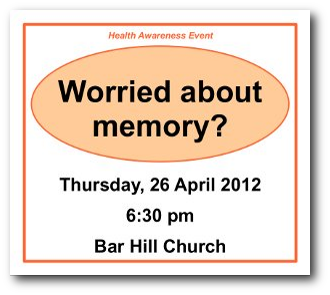
 health awareness event - worried about memory?
| home | meetings | events | miscellanea | contacts |
| hae |
health awareness event - worried about memory?There was a fantastic turnout, with over eighty members in the audience. Chris Stannard, acting chairman of the maple surgery patient participation group, opened the evening with a general welcome, an introduction to the work of the PPG (and encouragement to join!) and a description of the evening's programme.
Dr Sue Green began with a general overview of dementia and memory loss. Dementia is actually a term for a collection of diseases affecting the brain. In the UK, there are currently 700,000 sufferers of dementia and it is thought that this number will double by 2030. Who is affected by dementia? All age groups are susceptible but it is extremely rare in people under the age of 60. It is still rare for the under-70s (less than 3%).
Dementia is more common in
Dementia is less common in people
Some of the hallmarks of dementia include poor memory, particularly current events; trouble with names, faces and words; trouble with familiar activities; marked change in personality.
Some causes of dementia are treatable. These include various diet and vitamin deficiencies. However, dementia associated with Alzheimer's disease is caused by actual brain damage and cannot be cured.
There are different types of dementia. Alzheimer's disease is the most common. It has a gradual onset over time. The next most common type is vascular dementia. This can have a sudden onset and is associated with strokes, high blood pressure or heart disease. Another form of dementia is related to Parkinson's disease. Here the memory problems fluctuate, there may be hallucinations and the patient has difficulty with movement. Fronto temporal dementia is more common in men and strikes at a younger age. Although memory is usually well-preserved, there is marked emotional and personality changes and language can be affected. There is also a condition called mild cognitive impairment where sufferers have some problem with memory but don't actually have dementia. Some of these patients eventually go on to develop more serious memory problems but some do not and some even get better.
Acute confusion can also be the result of an underlying problem, such as an infection or medication. Once the underlying problem is identified and treated, the acute memory problems resolve.
Everyone with dementia is affected differently so the prognosis is very individual. What can be done to help someone with dementia?
The drugs we have at the moment work by boosting the signals in the brain. About a third of the patients on these drugs notice some improvement in their symptoms. Many others see a slowing of the progression of the disease.
Symptoms than can cause problems in advanced dementia include agitation, confusion, being noisy and wandering. This can be a reaction to an increasingly unfamiliar world and an inability to communicate. It is important to try and understand what is behind these problems.
Dr Green concluded her talk with the observation that no matter how severe a person's dementia is, a good quality of life is still possible.
Ms Grace Clark of the Cambridge and Ely branch of the Alzheimer's Society spoke next. The Alzheimer's Society is the UK's leading charity for research into Alzheimer's disease and for supporting patients and their carers.
Alzheimer's disease is characterised by memory loss and confusion. The biggest barrier to diagnosis is the patient refusing to see their GP about their symptoms. However, when memory problems affect everyday life, then it is time to get checked over. Many memory problems are related to medication or depression or other health issues, so a diagnosis of dementia is by no means certain. However, if a patient is diagnosed with Alzheimer's disease, the Alzheimer's Society has helplines for advice, both for patients and their carers and family and friends. The Alzheimer's Society also offers support services. Support groups get together for activities. Information points are open to offer general advice, details of local services and referrals to other agencies as needed. No appointment is necessary.
There is also an advisory service for newly-diagnosed patients which help with planning for the future and accessing local services. Patients can be referred by their GPs or can self-refer. When asked if family or friends were involved in advising, Ms Clark said that patients usually wanted their carers to know. The Alzheimer's Society then provides one advisor for the patient and one for the carers, thus getting a more complete picture of the situation.
The evening's final speaker, Dr Emma Tiffin, began with what a patient should expect at their GP appointment when they come in to discuss memory issues.
Dr Tiffin in the GP lead for the Older People's Mental Health services in this area. This service focusses on patient outcomes and thus, always wants feedback from patients. The service wants more services in the local community (primary care) and also wants more of a partnership between GPs, consultants, social services, etc. The idea is a patient-centred service.
A recent project, successfully trialled in Huntingdon, provides primary care services for patients with dementia. It is team-led service, with expert advice always available, so that patients are treated where it bests suits them. It is a much quicker process because the whole team is involved.
This project refers patients who need memory support to the Alzheimer's Society. Another aspect of the scheme involves training. Care home staff are often not well-trained in handling dementia patients. There also tends to be high staff turnover rates. The project helps with training staff, as well as carers, district nurses and GPs. The project also provides guidelines for GPs.
Another important aspect is patient reviews. Patients who are on medication are reviewed after a year to see how they are responding to treatment. And project members always want to know what's important to patients and their carers.
There will be a national scheme to test the over 75s who are in hospital for whatever reasons which then allows the GPs to follow up on them.
In response to a question about funding and tight budgets in the NHS, Dr Tiffin said that they were taking a proactive approach by trying to anticipate any cuts and make arrangements accordingly. The trick is to be ahead of the game.
The evening concluded with a lively question and answer session. At this point, Chris Stannard thanked the speakers and the members of the maple surgery patient participation group for arranging the event. He invited the audience to stay for refreshments and to visit the information stands. In addition to the Alzheimer's Society, five other organisations had information stands and volunteers to explain their work:
Copyright ©2010-2012 by the maple surgery patient participation group
Last updated on 1 June 2012 by the Webmaster